When you learn something new, a word in another language, how to solve an equation, a new song on guitar, nothing about your brain's basic wiring instantly disappears or gets added. What actually changes is smaller, but no less real: the strength of connections between existing brain cells.
Neurons talk through synapses
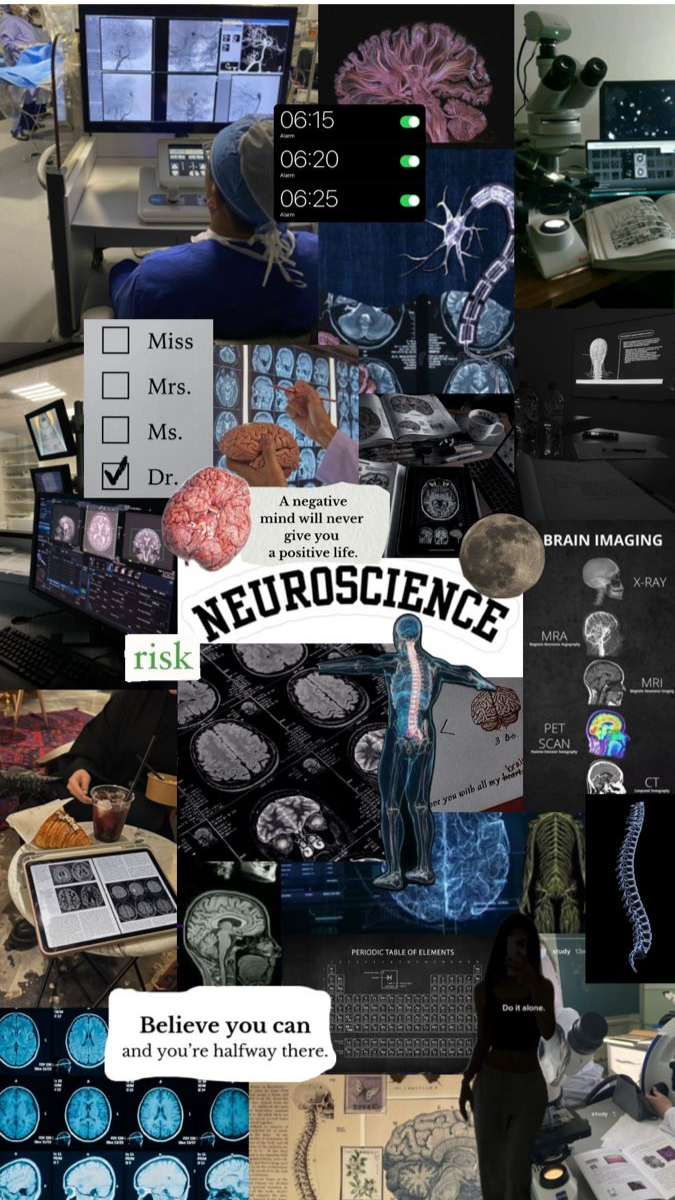
Your brain contains roughly 86 billion neurons, each one able to send signals to thousands of others through tiny junctions called synapses. When one neuron fires and successfully signals another, a small electrical and chemical exchange happens at that junction.
Learning happens when specific patterns of neurons fire together repeatedly. Each time that happens, the synapse connecting them gets a little more efficient at transmitting the signal. Neuroscientists sum this up with a well-known phrase: "neurons that fire together, wire together."
Why repetition works
This is the biological reason practice matters so much. The first time you try a new skill, the relevant neural pathway is weak and unreliable , which is why it feels effortful and mistake-prone. Each repetition strengthens that specific pathway a little more, which is why the same task gradually starts to feel automatic.
It's similar to a path forming across a grassy field. The first walk through leaves barely a trace. But walk the same route enough times, and a clear, easy-to-follow path emerges not because the field changed shape, but because that one route got reinforced through repeated use.
Sleep is part of the process, not a break from it
Learning doesn't stop when you close your notes. During sleep, especially certain stages, your brain replays and reorganizes recent activity, which appears to help strengthen the connections formed while you were awake. This is a big part of why cramming all night with no sleep tends to backfire you're skipping the step where a lot of that learning actually gets locked in.
Your brain can keep rewiring at any age
This ability to physically change based on experience is called neuroplasticity, and while it's especially strong in childhood, it doesn't switch off in adulthood. Adults learning a new language, instrument, or skill are undergoing the same basic process, existing neurons forming new, stronger connections, just sometimes at a slower pace than a developing brain.
Try it yourself
- Practice a small skill (a chord progression, a set of vocabulary words) in short sessions across several days instead of one long session, spaced repetition tends to build stronger connections than cramming.
- Notice how a skill you found difficult months ago now feels close to automatic, that's neuroplasticity, not talent, doing the work.
written by: Malika Salimi